The Street
Bag of BonesThe Street is the common lakeside path on the eastern side of Dark Score Lake. It connects Sara Laughs with resorts, cottages, and other parts of the TR, but its importance exceeds its practical use: it is described as the community’s common ground, a place where people of opposing loyalties may pass one another, and a route into the past and the lake’s supernatural center. Its changing condition reflects the decline of local interdependence, while its older history exposes the racial violence the community has tried to forget.
Setting and Routes
The Street runs north and south along the lake’s eastern edge, following a right-of-way identified in property deeds as common property. From the foot of the railroad-tie steps below Sara Laughs, turning left leads toward Dark Score Marina, past Warrington's and Buddy Jellison’s eatery and a succession of summer cottages sheltered among spruce and pine. The route in the other direction leads toward Halo Bay, though its overgrowth makes the walk much longer than the distance might suggest.
In summer, the path links homes and gathering places along the shore. On a bright morning after a holiday weekend, Michael Noonan walks south with grapefruit juice and finds the lakeside unusually quiet: distant fishermen remain on the water, while the cottages show only small traces of occupancy, such as bathing suits drying on a deck rail and an inflatable seahorse on a dock. The route’s everyday character is also apparent at Warrington's, where a long dock reaches The Sunset Bar, a smaller building where the resort’s guests gather for drinks.
The path is not simply scenery viewed from Sara Laughs. It is a public way that carries people between places, and its accessibility matters in a community where land, family ties, and local opinion shape who feels welcome. Its brush and fallen trees are signs that the shared route is no longer maintained as it once was.
Common Ground and Local Division
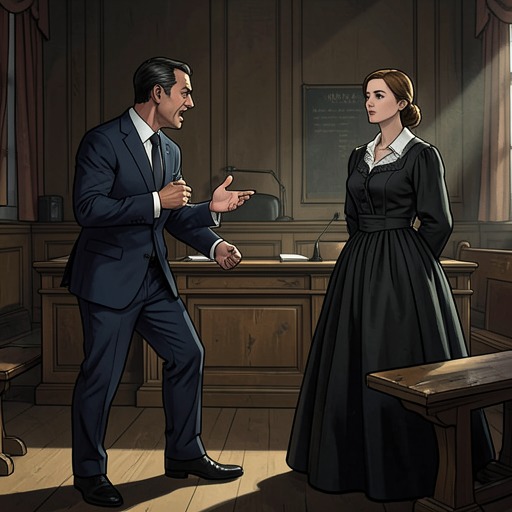
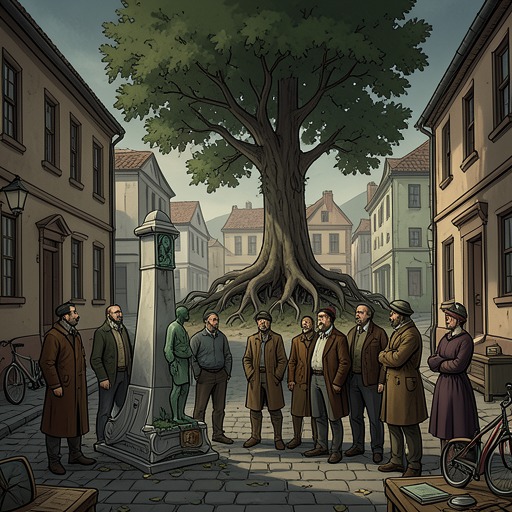
The Street is explicitly presented as the TR’s equivalent of a town common: a place where people with sharply different reputations or allegiances can walk side by side. That ideal is invoked when Max Devore confronts Michael, who answers by recalling the principle that anyone may use the path. The claim of openness, however, exists alongside a town increasingly divided by Max’s influence. Bill Dean describes local life as a delicate arrangement in which one restless person can keep everyone else from resting; he also observes that Mattie Devore has been socially isolated, with some townspeople refusing to speak to her.
The path’s public status does not erase the town’s economic pressures or its informal power structures. Max sends money into a community accustomed to hard times, and local businesses and residents become entangled in the influence surrounding him. In that context, The Street’s image of shared passage is both a civic principle and a contested one: people may occupy the same route without enjoying equal standing or protection.
Its history makes the contradiction sharper. At the turn of the twentieth century, more than forty Black settlers lived in the area for a time. When Son Tidwell bought land on behalf of his extended family, white residents protested their arrival in openly racist terms. The feared shantytown did not materialize; instead, the settlement developed into neat white cabins around a larger communal building that may have served as a meeting, rehearsal, or performance space. Later local self-description praised the Tidwells for keeping to themselves and refusing charity, language that can sound like respect while also making isolation appear virtuous.
The path becomes the setting where that separation is challenged. Sara Tidwell walks along it in a white dress, at times accompanied by her son, Kito. The people around her do not all treat her as an outsider; some treat her as a neighbor. Jared Devore’s hostility is intensified by precisely that ordinary recognition. The Street therefore represents more than a neutral public right-of-way: it is a space where the community’s stated customs and its racial hierarchy collide.
The Past Along the Shore
In its present-day condition, The Street is overgrown, and neighbors no longer join together to keep it clear as they once did. Max recalls an earlier period when the route was broad, grassy, and busy with residents walking in groups. He describes the old path as a community conduit, through which people communicated and sustained one another in a landscape with few modern services. The remembered street was not only a road but an expression of neighboring as a practical necessity.
That recollection opens onto the Land of Ago, a timeless vision of the lakeside in the late nineteenth or early twentieth century. In this remembered community, people emerge from the woods and gather beside the lake; the path is where the town recognizes itself through conversation and shared presence. The contrast with the neglected modern route makes communal decline visible in the landscape. The past appears golden in memory, but the older history also contains exclusion and violence, so the image of a more connected community is not an uncomplicated account of moral progress.
The Street’s role in Sara and Kito’s history brings that conflict into focus. Their presence on the path challenged the boundary imposed by white residents who expected them to remain apart. The later discovery of their remains near the lake confirms that the public landscape had concealed a history of murder and concealment. The path thus connects present-day characters not merely to an abstract past, but to the place where the community’s treatment of Sara and her son became part of the ground beneath their feet.
Threshold to the Supernatural
For Michael, The Street is also a threshold between the familiar grounds around Sara Laughs and the uncanny force centered on the lake. He repeatedly encounters a birch tree beside the path that resembles a woman from both the shore and the water. Seen with a half-dead pine behind it, the tree takes on the appearance of the Green Lady; its pointing branch suggests a direction north. Michael later interprets the image as an invitation to go that way, though the apparent figure remains a tree and the meaning comes from the landscape’s unsettling effect on him.
The route’s proximity to the water links it to Michael’s visions. After a frightening encounter in the lake, he reaches shore and stands on The Street, looking back toward the water and the swimming float. Later, he returns to the birch and peers into the lake expecting the drowned boy and the associated signs of his vision, but sees none of them. The contrast between expectation and absence does not make the location ordinary again; it keeps the lake and path suspended between physical setting and supernatural perception.
Michael also imagines that the TR’s shared land, air, lake, and underground water might support a collective consciousness. In this speculation, The Street is one of the connections binding the community, a common route as well as a possible channel between minds. He understands the path as leading toward the heart of a world where time grows thin and spirits rule. Its ordinary geography consequently acquires a second map: the visible lakeshore and the unseen relations, memories, and presences that converge there.
Meaning and Legacy
The Street gathers the novel’s tensions into one modest piece of shared ground. It is a route to resorts and cottages, a place where neighbors may meet, and a public space whose ideal of common use is tested by money, social ostracism, and racism. Its present neglect contrasts with the remembered days when residents maintained it together; its older history unsettles any easy belief that community and neighborliness were once universal.
At the same time, the path’s openness makes it a passage through which suppressed history returns. Sara and Kito’s place in the community, their movement along the lakeshore, and the discovery of their remains bind the physical setting to the consequences of exclusion. For Michael, the same route runs toward the supernatural center of the story. The Street is therefore neither merely a road nor simply a symbol: it is where local life, buried history, and the lake’s disturbing presence meet.